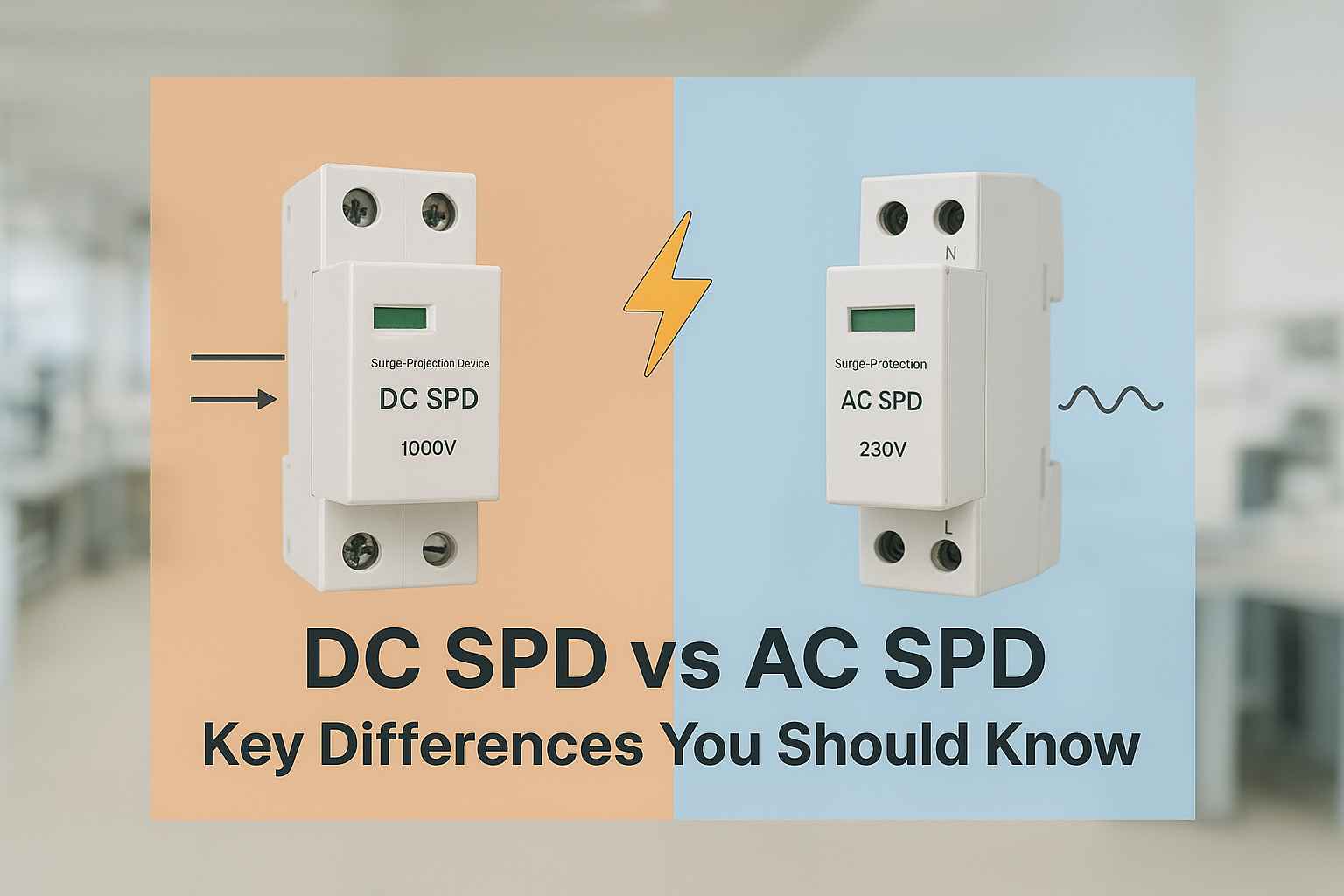
DC SPD vs AC SPD: Key Differences You Should Know
Discover the key differences between DC SPD and AC SPD in solar power systems. Learn how each protects your setup from voltage surges and ensures long-term safety.
DC SPD vs AC SPD: Key Differences You Should Know
Due to the escalating demand for energy on a global scale, the world has turned into a mixture of AC (Alternating Current) and DC (Direct Current) systems in homes, industries, and even renewable energy infrastructures. Consequently, the necessity for electrical safety has reached a high level of importance. Surge Protection Devices (SPDs) among the most essential safeguards, are the ones that put in the least amount of work yet are the most successful in the prevention of the equipment that is the victim of the overvoltage transients.
One of the main operating principles of a DC or an AC SPD being the same is the fact that the energy is diverted safely to the ground, however, their operational characteristics are very different. It is important for electrical engineers, installers, and system designers to understand these differences in order to be able to provide the right protection in different electrical environments.
Understanding Surge Protection Devices (SPDs)
One of the goals of Surge Protection Devices is to protect the wired network and appliances against temporary overvoltages, that is, to avoid a sudden and brief increase in voltage. Such cases may be caused by a lightning strike, a switching operation or an electromagnetic disturbance. Such surges are capable of tearing down the system's insulation, electrically damaging the semiconductors, and, in fact, causing the entire system to stop working.
In case a surge protective device (SPD) is installed in the system, the SPD will restrict the voltage to a safe level and will transfer the extra energy to the earth by a low-resistance path. Then, it reverts to its high-resistance state and therefore, it is available for a new surge.
SPDs are typically categorized into three types:
- Type 1 SPD: Installed at the service entrance to protect against direct lightning surges.
- Type 2 SPD: Used downstream in distribution panels to protect against indirect surges and switching operations.
- Type 3 SPD: Installed close to sensitive loads, providing fine protection for end-user equipment.
However, the difference between AC and DC SPDs is not in their classification but in their internal design, application voltage, and current behavior.
1. Fundamental Difference Between AC and DC SPDs
The fundamental distinction lies in the nature of the current they protect:
An AC SPD is a device that limits surges in Alternating Current circuits, meaning circuits where the current changes direction periodically (usually 50Hz or 60Hz).
A DC SPD is a device that limits surges in Direct Current circuits, i.e., DC circuits, where the current flows in one fixed direction without zero-crossing.
The difference in current behavior has an impact on how surges are put out after they have been released.
For AC systems, the current waveform crosses zero voltage 100 or 120 times per second, which by itself helps to extinguish arcs formed during the surge discharge.
Conversely, with DC, there is no zero-crossing - the voltage stays at the same level. So if an arc is created, it can just keep going. Therefore, DC SPDs have to incorporate more powerful arc extinguishing chambers and a higher insulation level to be able to prevent the destruction of the device or the occurrence of a fire.
2. Structural and Design Differences
It is also true that both AC and DC SPDs apply non-linear protective components such as Metal Oxide Varistors (MOVs), Gas Discharge Tubes (GDTs), and Spark Gaps, but the way they are configured and designed is quite different.
AC SPD Design Features:
- Optimized for alternating polarity.
- Simpler arc extinguishing process due to natural current zero-crossing.
- MOVs are the primary protection element.
- These are rated for phase-to-neutral or phase-to-earth AC voltages (for example, 230V, 400V).
- They operate at a lower continuous voltage stress level than DC systems.
Features of a DC SPD:
- It is built to endure a continuous voltage stress from DC.
- They have arc-quenching chambers or a magnetic blowout mechanism.
- They are polarity-sensitive (i.e. the positive and negative terminals must be connected correctly).
- They are rated for higher voltages (for instance, 600V DC, 1000V DC, 1500V DC).
- Often use a combination of MOV + GDT to enhance durability and response time.
Because of these design differences, using an AC SPD in a DC circuit-or vice versa-is unsafe and can lead to catastrophic failure.
3. Application Scenarios
| Application | Type of SPD | Typical Use |
|---|---|---|
| AC SPD | AC Systems | Mains distribution boards, commercial wiring systems, HVAC systems, lighting control, data centers |
| DC SPD | DC Systems | Solar PV arrays, battery storage systems, EV charging stations, UPS systems, telecom DC networks |
For example, in solar photovoltaic systems, DC SPDs are installed between the PV strings and inverter to protect against lightning surges on the DC side. Meanwhile, AC SPDs are installed at the inverter output to safeguard against surges entering the grid.
4. Voltage Ratings and Performance Parameters
AC SPDs:
- Are typical of operating voltages such as 230V (single-phase) or 415V (three-phase).
- Are intended for transient voltage to be limited up to 6kV.
- Possess Uc (maximum continuous operating voltage) values which depend on the grid in consideration.
DC SPDs:
- Have their steady voltage rating much higher than those of AC SPDs like 600V, 1000V, or 1500V DC are common values.
- Are capable of only one million times long-duration surge energy without any internal rupturing.
- Have very low residual voltage (Up) to be able to keep the most sensitive devices safe from excesses.
5. Installation and Polarity Sensitivity
AC SPD Installation:
- Typically connected between phase-neutral, phase-earth, or phase-phase.
- Polarity is irrelevant due to alternating current flow.
- Installation is straightforward with minimal wiring considerations.
DC SPD Installation:
- Requires careful connection between positive (+), negative (-), and earth.
- Polarity must be strictly observed.
- Often installed near the solar combiner box or battery terminals.
- Fuses or DC isolators may be included for safe maintenance.
6. Testing and Standards
The performance and reliability of SPDs are governed by international standards that define their testing, classification, and labeling.
AC SPD Standards:
- IEC 61643-11 (Low-voltage AC power systems)
- IS/IEC 61643-1 (Indian standard)
DC SPD Standards:
- IEC 61643-31 (SPDs for photovoltaic systems)
- UL 1449 (for North American compliance)
7. Maintenance and Service Life
Both AC and DC SPDs have finite service lives, determined by the number of surge events they handle and the magnitude of each surge.
AC SPDs in stable grid networks may last several years, as surge activity is relatively low.
DC SPDs in outdoor solar or EV scenarios are exposed to more severe conditions, more frequent transients, and temperature changes, so they have to be checked and replaced regularly.
8. Cost, Reliability, and Safety Factors
DC SPDs are pricier than AC ones because of the need for advanced insulation and arc extinguishing, but the extra cost is worth it because of the higher risk of DC systems.
Incorrect use of an SPD type may lead to:
- Arcing that is sustained and thermal runaway.
- Damage to the equipment or electrical fires.
- Complete system downtime and a repair bill that is expensive.
FAQs
Conclusion
The difference between DC SPD and AC SPD goes beyond the type of current they handle—it defines their construction, safety, and application suitability.
AC systems have SPDs that are helped by a periodic zero-crossing, thus a simpler arc suppression can be used. A DC system has to be equipped with an advanced insulation, a strong arc chamber, and a precise polarity handling in order to be able to discharge the surge safely.
One of the most trusted electrical safety brands on the market, Blitz Electrical, is still coming up with new and innovative high-performance SPDs which are suitable for both AC and DC environments, thus the protection can be complete in any kind of modern power infrastructures.