.jpg)
A Guide to Choosing the Right Miniature Circuit Breaker
Choose the right Miniature Circuit Breaker (MCB) for your electrical system with this complete guide covering types, ratings, applications, and expert safety tips.
A Guide to Choosing the Right Miniature Circuit Breaker (MCB)
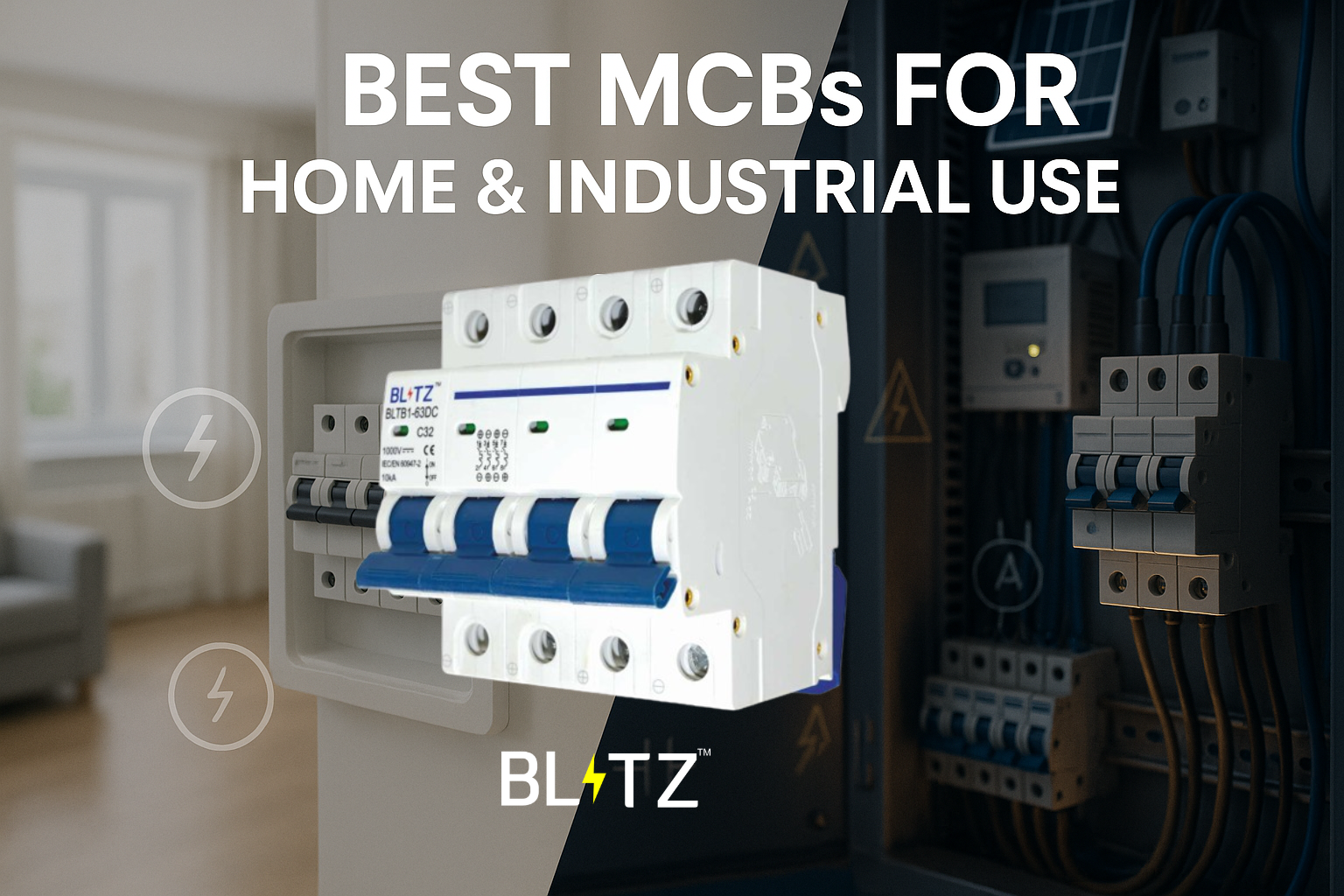
Miniature Circuit Breakers (MCBs) are the must-have elements of any present-day power system. They are the instruments that, by their very nature, keep safe the human beings, the electrical devices, and the general infrastructure, by averting the overload situations and the short-circuit ones. If you are wiring a house, or if you are upgrading a certain commercial space, or if you are designing a power panel for a factory-it is a safety plus and a reliability plus, by which we mean, an MCB that is properly chosen.
On the other hand, the electrical market is stuffed with so many sorts, ratings, and configurations of MCBs that choosing one becomes a downright puzzle for most people. This tutorial will lead you through the entire MCB world and will leave you with the right MCB selection for your working situation.
What Is a Miniature Circuit Breaker (MCB)?
An MCB is an automatically operated electrical switch designed to protect a circuit from excessive current caused by overload or short circuit. When a fault occurs, the MCB automatically “trips” or disconnects the electrical supply, preventing system damage, fire, or equipment failure.
MCBs are widely used in homes, offices, factories, telecom systems, solar installations, and more because they offer:
- Faster response than fuses
- Reusability (can be reset, unlike fuses which must be replaced)
- Higher precision
- Enhanced protection means
Key Factors to Consider When Choosing the Right MCB
To select an appropriate MCB, you need to consider a few technical and practical aspects. Most of them are figured out from the list below.
a. Determine the Current Rating (Amperes)
Current rating is the quantity of current after which the MCB will disconnect the circuit. A MCB with the appropriate rating can perform the normal load without the nuisance of tripping and can also be used to protect a circuit in a fault condition.
Common ratings of MCB are: 6A, 10A, 16A, 20A, 32A, 40A, 63A
Instruction:
- Light circuits: 6A-10A
- Socket outlets: 16A–20A
- Heavy appliances (AC, geyser): 25A–32A
- Industrial loads: 40A–63A
b. Choose the Right Breaking Capacity
Breaking capacity refers to the maximum fault current the MCB can safely interrupt. It’s usually expressed in kA (kiloamperes).
Typical breaking capacity options:
- 6kA - suitable for homes and light commercial areas
- 10kA - commercial buildings, offices, shops
- 16kA+ - industrial areas with high fault levels
c. Select the Trip Curve Type
Trip curves show the time the MCB takes to react to an overload or a short circuit.
- B Curve: Trips at 3–5× rated current — ideal for home loads.
- C Curve: Trips at 5–10× rated current — suited for commercial loads and devices with moderate inrush current.
- D Curve: Trips at 10–20× rated current — used for heavy industrial machinery.
d. Consider the Number of Poles
- SP (Single Pole): 1 phase
- SPN: Phase + neutral isolation
- DP: Phase + neutral (full isolation)
- TP: 3-phase equipment
- TPN: 3 phases + neutral isolation
- 4P: 3 phases + neutral protection
e. Check the Quality and Standards Compliance
- IEC/EN 60898
- IS/IEC 60898-1
f. Mechanical & Electrical Endurance
Look for:
- High electrical endurance cycles
- High mechanical endurance cycles
- Wide operating temperature range
g. Application-Specific Requirements
- DIN rail compatibility
- Modular width
- Status indicator windows
- Arc protection
- Integration with RCBO / smart systems
Common Mistakes to Avoid
- Choosing an MCB based only on price
- Selecting a high current rating to avoid tripping
- Ignoring breaking capacity
- Using B-curve MCBs for motor loads
- Failing to calculate total connected load
- Not considering future expansion
Not committing these mistakes guarantees that your electrical system will be safer and more economical.
FAQs
Conclusion
Finding the right Miniature Circuit Breaker is by no means just a matter of choosing any switch randomly from the shelf. One must know the electrical load, safety requirements, place of installation, and short-circuit levels. The correct use of MCB not only keeps your appliances and wiring safe but also makes sure the safety of your home, office, or industrial premises, later on, is secured.
Knowing your needs will allow you to decide on an MCB that fits your situation. Current rating, breaking capacity, trip curve, pole configuration and safety standard compliance are the main features which you should use to find the right MCB for you. Quality should always be your first consideration and, if you are not sure, ask a qualified electrician.
An appropriately selected MCB is more than just a device- it is a major factor in a safe and reliable electrical system.